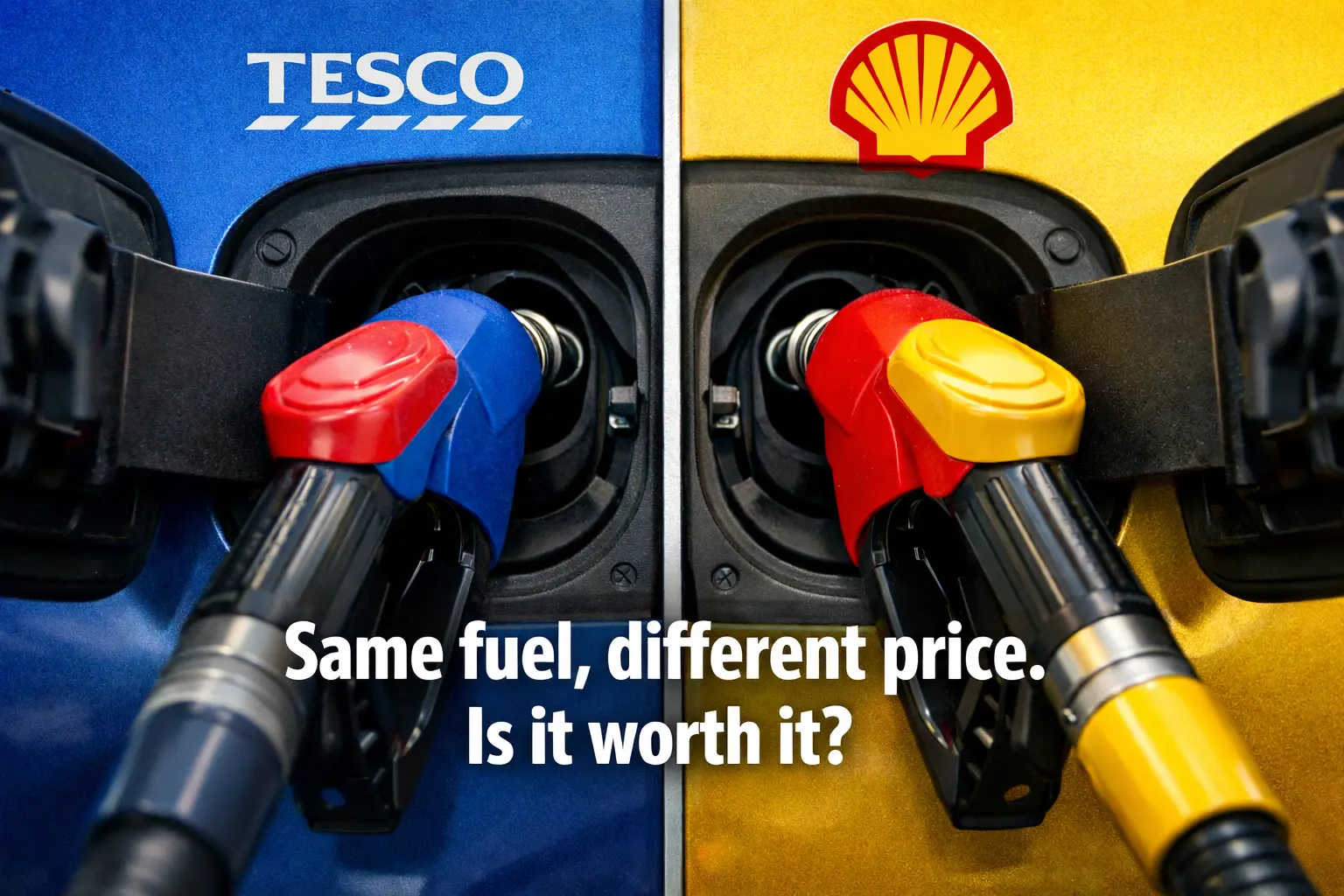

Your mate swears Asda petrol ruined his engine. Your dad only uses Shell "because it's better quality." Your colleague says Tesco fuel is watered down. Your wallet is crying.
Who's actually right?
With supermarket fuel typically 7-10p per litre cheaper than branded stations, this question matters. The difference between filling up at Tesco (133p/L) versus Shell (142p/L) is £4.50 per tank, or £234 per year for an average driver.
So is that saving a smart move or slow engine damage? We spoke to mechanics, checked the regulations, and dug into the science. Here's the truth.
👉 Find the cheapest petrol or diesel prices near you
💷 The Short Answer: No, Supermarket Fuel Is NOT Bad for Your Car
UK fuel regulations are strict. All petrol and diesel sold in the UK — whether from Tesco, Shell, or a random independent station — must meet exactly the same British and European standards:
Petrol: BS EN 228 and E10 specification
Diesel: BS EN 590 specification
These standards cover:
Octane rating (RON 95 minimum for regular unleaded)
Sulphur content (max 10ppm)
Detergent additives (minimum required levels)
Density and volatility
Contaminant limits
If a fuel doesn't meet these standards, it cannot legally be sold in the UK. Full stop.
So when you fill up at Asda, you're getting fuel that meets exactly the same regulatory baseline as BP, Esso, or Shell regular unleaded.
🔬 But What About "Quality" and "Additives"?
This is where it gets nuanced.
The Base Fuel Is Identical
Supermarkets and branded stations often buy from the same refineries. The tanker that delivers to Tesco in the morning might deliver to Shell in the afternoon. Same fuel, different branding.
The Difference: Additive Packages
Branded stations (Shell, BP, Esso) add extra detergents and cleaning additives beyond the legal minimum. These proprietary blends are marketed as:
Shell V-Power
BP Ultimate
Esso Synergy Supreme+
What do these additives actually do?
Help keep fuel injectors and intake valves cleaner
Reduce carbon deposits over time
May improve fuel economy by 1-2% (manufacturer claims)
The catch: These premium fuels cost 25-30p per litre more. That's £12.50-15 extra per tank.
🔧 Why Supermarket Fuel Gets a Bad Reputation (And Why It's Wrong)
The "supermarket fuel is bad" myth persists for a few reasons:
Reason 1: Confirmation Bias
Someone fills up at Asda, their car develops an unrelated problem a week later, and they blame the fuel. Meanwhile, thousands of other drivers using the same fuel have zero issues.
If supermarket fuel genuinely caused engine problems, we'd see:
Mass recalls and scandals
Mechanics refusing to recommend it
Manufacturer warnings
Legal action
None of this exists. Because the fuel is fine.
Reason 2: The 2007 Tesco Contamination Incident
In 2007, a batch of Tesco fuel was contaminated with silicon, affecting around 250 cars. This made national news and became the foundation for the "supermarket fuel is bad" myth.
But context matters:
This was nearly 20 years ago
It affected ONE batch from ONE supplier
Tesco compensated all affected customers
Contamination can happen to ANY fuel supplier (Shell had issues in Aberdeen in 2017, BP in Edinburgh in 2019)
Modern testing catches these incidents faster
Reason 3: Branded Fuel Marketing
Shell, BP, and Esso spend millions on marketing their premium fuels. Part of that strategy involves implying (without directly stating) that supermarket fuel is inferior.
This benefits them in two ways:
Keeps people buying expensive premium fuel
Creates doubt about cheaper alternatives
The reality: All UK fuel meets identical baseline standards. The difference is additives, not quality.
Reason 4: The Placebo Effect
People who switch to branded fuel and "feel" a difference are experiencing psychological effects, not mechanical ones. Blind tests consistently show drivers cannot tell the difference between supermarket and branded regular unleaded.
What Actually Causes Fuel-Related Problems
When cars DO have fuel system issues, it's usually:
Old/dirty fuel filters (maintenance issue)
Contaminated fuel tanks (any fuel supplier)
Wrong fuel type (petrol in diesel or vice versa)
Aged fuel in rarely-driven cars (sitting for months)
None of these are specific to supermarket fuel.
🚗 What Car Manufacturers Actually Say
We checked owner's manuals for the UK's most popular cars:
Car | Manufacturer Requirement | Premium Needed? |
Ford Fiesta | 95 RON minimum | ❌ No |
Vauxhall Corsa | 95 RON minimum | ❌ No |
VW Golf | 95 RON minimum | ❌ No |
BMW 3 Series | 95 RON minimum, 98 RON recommended | ⚠️ Optional |
Nissan Qashqai | 95 RON minimum | ❌ No |
Toyota Corolla | 95 RON minimum | ❌ No |
Mercedes C-Class | 95 RON minimum, 98 RON recommended | ⚠️ Optional |
Honda Civic | 95 RON minimum | ❌ No |
Audi A4 | 95 RON minimum, 98 RON recommended | ⚠️ Optional |
Hyundai Tucson | 95 RON minimum | ❌ No |
Key finding: 95 RON (standard supermarket unleaded) is the minimum for virtually every car. Some German cars recommend 98 RON but don't require it.
💡 When Premium Fuel Actually Matters
There are a few specific scenarios where premium fuel makes sense:
1. Manufacturer REQUIRES 98+ RON
Some high-performance cars explicitly require super unleaded:
Porsche 911 Turbo
BMW M3/M4
Mercedes-AMG models
Some Audi RS models
Check your manual. If it says "requires" or "must use" 98 RON, then use it. If it says "recommended" or "for optimal performance," standard fuel is fine.
2. High-Performance Driving
If you're regularly:
Track driving
Towing heavy loads
Driving in extreme conditions
Premium fuel's higher octane can prevent engine knock under high stress.
3. Very Old Cars (Pre-2000)
Older engines designed before modern fuel standards may benefit from premium fuel's extra additives. But even this is debatable.
For Everyone Else?
You're wasting £12-15 per tank for negligible benefit.
🔍 The Additives Debate: Do They Really Help?
Premium fuels advertise proprietary additive packages. Let's break down the claims vs reality:
Claim: "Cleans Your Engine"
Reality: All UK fuel contains detergent additives (required by law). Premium has more, but the baseline is already effective for modern engines.
Independent testing: Some studies show 1-2% improvement in fuel economy after using premium fuel for several tanks. But that 1-2% gain doesn't offset the 20% price premium.
Claim: "Prevents Carbon Build-Up"
Reality: Modern engines with direct injection are prone to carbon build-up regardless of fuel type. Premium fuel helps slightly, but doesn't eliminate the issue.
Mechanic perspective: "If you want to prevent carbon build-up, drive your car properly — don't just do short trips, get it up to temperature, and use higher RPMs occasionally. That's more effective than expensive fuel."
Claim: "Better Performance"
Reality: Only noticeable in high-performance engines designed to exploit higher octane. Your Vauxhall Corsa won't feel any different.
🧪 The Water/Contamination Myth
The myth: "Supermarket fuel is watered down or contaminated more often."
The reality:
All fuel suppliers face the same contamination risks
Supermarkets have high turnover = fresher fuel
Contamination incidents are extremely rare and affect all fuel types equally
When contamination happens, it makes national news (Shell Aberdeen 2017, BP Edinburgh 2019) — not exclusive to supermarkets
Fuel testing is mandatory: Random samples are tested regularly. Contaminated fuel is caught before it reaches consumers in almost all cases.
💳 What About Loyalty Cards and Fuel Rewards?
If you're debating supermarket vs branded fuel, factor in loyalty schemes:
Tesco Clubcard
1 point per £1 on fuel = 1p value
Effective discount: 1p/L
Makes Tesco even cheaper
Sainsbury's Nectar
1 point per £1 = 0.5p value
Regular 5p/L off events
Check app before filling
Shell Go+
1 point per litre
Redeem for fuel discounts
Still doesn't overcome 10p price premium
BP Plus
Points on fuel and shop purchases
Similar to Shell — doesn't offset premium
Verdict: Supermarket loyalty schemes add value. Branded schemes don't overcome the base price difference.
🔍 FAQs About Supermarket Fuel
Q: Will supermarket fuel void my warranty? A: No. As long as it meets the manufacturer's specified RON rating (usually 95), your warranty is valid.
Q: Why do some people swear their car runs better on branded fuel? A: Placebo effect, confirmation bias, or they coincidentally fixed another issue (spark plugs, air filter) when they switched fuel. Blind tests show no performance difference.
Q: Is supermarket diesel different too? A: Same story. All diesel must meet EN 590. Supermarket diesel is not lower quality.
Q: What about supermarket premium (Tesco Momentum, Sainsbury's Super)? A: These are 99 RON fuels with added additives, comparable to Shell V-Power or BP Ultimate. Still cheaper than branded premium.
Q: Can I mix supermarket and branded fuel? A: Yes, they're 100% compatible. Your car doesn't care.
Q: Should I use fuel injector cleaner additives? A: If you're concerned, use a bottle of injector cleaner once a year (£5-10). Far cheaper than premium fuel year-round.
Q: Does E10 petrol affect this? A: E10 (10% ethanol) is now standard in the UK. All suppliers use it. Same standards apply whether supermarket or branded.
Q: What if I accidentally use the wrong fuel? A: That's a different issue (petrol in diesel or vice versa). Call recovery immediately, don't start the engine. This risk is equal regardless of where you buy.
🧾 Final Thoughts
The "supermarket fuel is bad" myth has cost UK drivers millions over the years. It's marketing genius by branded stations — make you doubt the cheaper option so you pay a premium for identical baseline quality.
Here's the truth:
Supermarket fuel meets the same legal standards as branded
Your car manual specifies the minimum RON — usually 95 (supermarket regular)
95% of UK cars see zero benefit from premium fuel
The £200-350 you save annually by using supermarket fuel is real money
Your car doesn't care whether the fuel comes from Tesco or Shell. But your wallet does.
Stop wasting money on expensive fuel myths. Start using supermarket fuel and spend the savings on things that actually matter — proper servicing, good tyres, or just keeping the money in your pocket.
👉 Find the cheapest petrol or diesel prices near you
🔧 Related Tools from Resolvo
Journey Cost Calculator — Calculate trip fuel costs
MPG Calculator — Work out your real fuel efficiency
PCP Calculator - Calculate your car finance monthly payments
HP Calculator - calculate your hire purchase finance monthly payment
Got an unfair parking fine while filling up? Resolvo writes free, sound appeal letter in 2 minutes.
Free Resolvo Tools
Related Posts
Find Out How Much Your Journey Will Cost?
27 November 2025
Calculate your UK journey costs accurately — fuel, parking, tolls & hidden expenses. Free calculator + real examples. Is driving cheaper than the train?
Check Your Car’s Emissions in Seconds — and Understand What It Means
9 November 2025
Use Resolvo’s free emissions checker to discover your car’s CO₂ output, tax band and eligibility for clean‑air zones. No sign‑up, instant results.
What is SORN: Everything You Need to Know
6 November 2025
Need to declare your car off the road? Learn how SORN works, when to apply, penalties for not declaring, refund eligibility and your insurance options.
Buying a Used Car? Check Its MOT History & Avoid Problems
21 October 2025
Buying a used car? Use Resolvo’s MOT Checker to instantly view a car MOT status, expiry date, and full test history. Make smart, confident decisions before you buy.
Got a ULEZ or Congestion Charge Fine? Here’s How to Beat It
16 August 2025
Got with a Congestion Charge or ULEZ fine? Learn how to appeal it in minutes, what your options are, and how Resolvo helps you fight back — for free.
Exposed: How Parking Companies Get Your Details
30 April 2025
Find out how parking firms use DVLA data to get your details and how to use Resolvo to fight against your parking ticket.

🅿️ Blue Badge Rules : Everything You Need to Know
13 January 2026
Confused about Blue Badge rules? Learn where you can park, yellow line limits, London exceptions, and the myths that can lead to £1,000 fines.