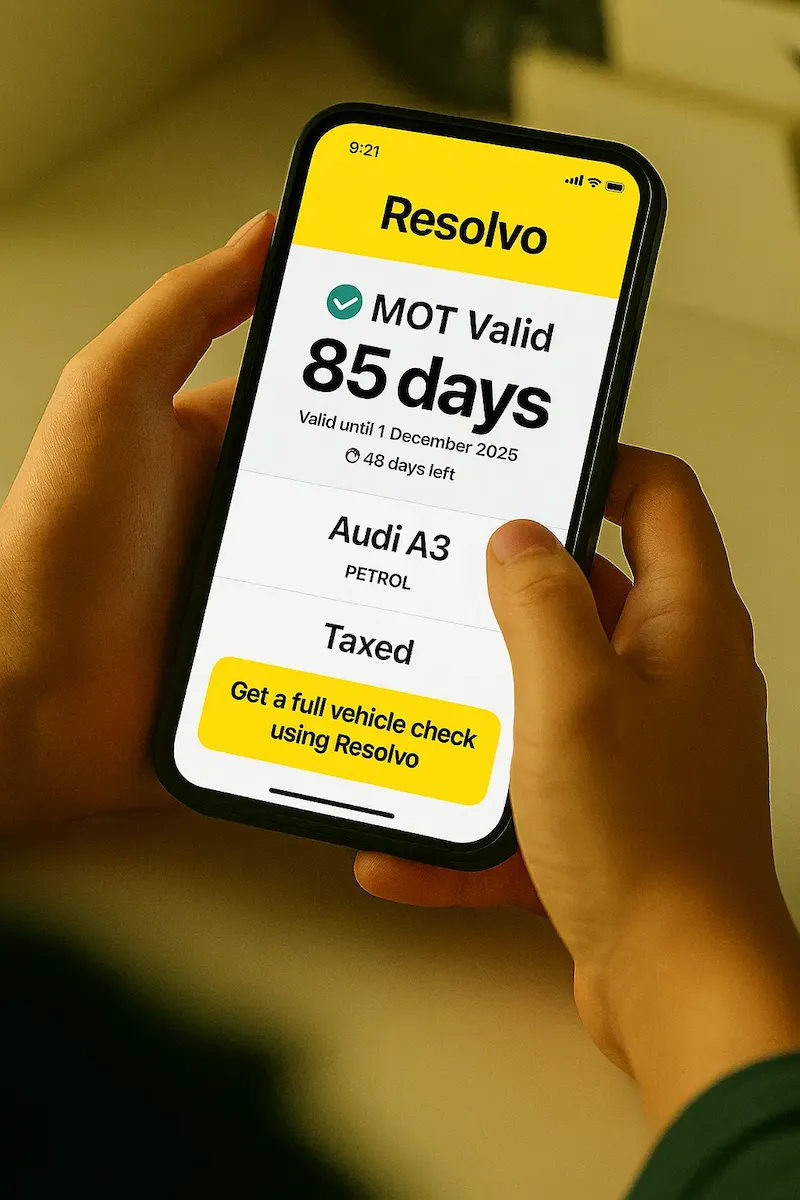

Your car just passed its MOT. Great news, right? Then you look at the certificate and see three "advisories" listed. Worn brake pads. Minor oil leak. Tyre tread approaching the limit.
The garage says they're "nothing to worry about" — your car passed after all. Think of advisories as your 12-month heads-up — ignore them, and there's a good chance they'll become next year's fail.
Here's everything you need to know about MOT advisories, what the different fault categories mean, and how to use them to avoid expensive failures.
👉 Check any cars MOT history — free tool
📌 What Is an MOT Advisory?
An MOT advisory is something the examiner has noticed that could become more serious in the future. It's not bad enough to fail you today, but it's worth monitoring.
Think of advisories as yellow flags — not critical now, but heading that direction.
Advisories highlight potential issues that did not cause the vehicle to fail but may require attention in the near future.
Example advisory: "Nearside front brake pad wear sensor wires exposed" — means the brake pad wear indicators are visible — a sign your pads are getting thin and should be checked soon
🚦 The Four MOT Fault Categories (2018 System)
Since 2018, MOT defects are categorised as Dangerous, Major, Minor, or Advisory. Here's what each one means:
Category | Pass/Fail | Can You Drive? | Action Required |
Dangerous 🚫 | FAIL | No — immediate driving ban | Cannot drive at all, even with valid MOT |
Major ❌ | FAIL | Only if previous MOT still valid | Must fix before retest |
Minor ⚠️ | PASS | Yes | Monitor, but car passes |
Advisory 💡 | PASS | Yes | Should be fixed soon |
Key point: Unlike dangerous or major defects, advisories don't cause your car to fail, but you should not ignore them.
💡 Advisory vs Minor Defect: What's the Difference?
This confuses a lot of people because both still let your car pass — but they’re not the same thing.
Minor Defect
An official MOT defect category under DVSA rules
Recorded on the MOT certificate
Based on defined testing standards
Indicates something is worn or deteriorating, but not serious enough to fail
Example: Slight play in a suspension component
Advisory
Not a defect category
A tester’s professional note, added at their discretion
Highlights something that may need attention in the future
Not governed by pass/fail thresholds
Example: “Offside rear tyre starting to perish”
Key point: Only Dangerous, Major, and Minor are formal MOT defect categories. Advisories are best‑practice warnings, not regulated faults.
Bottom line: Both are early warnings — but minor defects are formally defined by DVSA, while advisories are judgement‑based notes. Neither causes a fail, but ignoring either increases the risk of future problems.
📊 The 6 Most Common MOT Advisories
Based on data from garages across the UK, these are the 6 most common advisories when UK motorists have their car MOT'd:
1. Worn Brake Pads or Discs
"MOT lists worn brake pads or discs means the friction material is close to its minimum thickness"
What it means: Your brakes still work but are approaching the legal limit (usually 1.5mm)
Cost to fix: £80–£200 per axle What happens if ignored: Next year's failure, or worse — brake failure while driving
2. Tyre Tread Approaching Limit
What it means: Tread depth is between 2mm and 1.6mm (legal minimum is 1.6mm)
Cost to fix: £50–£120 per tyre What happens if ignored: Fail next MOT, reduced grip in wet weather, potential £2,500 fine if caught below 1.6mm
3. Minor Oil or Fluid Leaks
What it means: Small leak from engine, gearbox, or power steering
Cost to fix: £50–£300 depending on source What happens if ignored: Leak worsens, potential engine damage, fail next MOT
4. Corroded Exhaust or Minor Smoke
Advisories for corroded exhaust or minor smoke emissions can escalate into MOT failures if ignored
What it means: Rust on exhaust, small hole, or slight smoke from tailpipe
Cost to fix: £100–£400 for exhaust repair What happens if ignored: Excessive noise, emissions failure, potential catalytic converter damage
5. Suspension Component Wear
What it means: Bushes, dampers, or springs showing wear but still within limits
Cost to fix: £100–£500 depending on component What happens if ignored: Handling deteriorates, fail next MOT, potential safety issue
6. Worn Wiper Blades or Washer Issues
What it means: Blades leaving streaks or washer jets not working properly
Cost to fix: £10–£30 for wipers, £20–£50 for washer fix What happens if ignored: Reduced visibility, easy MOT fail
🚗 Real Scenarios: Why Advisories Matter
Scenario 1: The Ignored Brake Advisory
2024 MOT: "Nearside rear brake pad wear 3mm remaining" — Advisory, car passed 2025 MOT: "Nearside rear brake pad below minimum thickness" — Major defect, car failed
Result: Emma ignored the advisory. Cost her £150 for emergency brake repairs + £55 for the failed MOT + £27 for the retest. If she'd fixed it when advised, she'd have only paid £150 and sailed through.
Scenario 2: The Tyre Tread Warning
March 2024 MOT: "Offside front tyre tread depth 2.2mm" — Advisory September 2024: Tom's car skids in wet weather. Tread now at 1.4mm (below legal) Result: Accident + £100 fine + 3 penalty points + insurance issues
Scenario 3: The Small Oil Leak
2024 MOT: "Engine oil leak, but not excessive" — Advisory 8 months later: Leak worsens, engine runs low on oil, seizes up Result: £3,000 engine replacement that could have been a £150 gasket fix
💳 Should You Fix Advisories Immediately?
It depends and you should always speak to a mechanic. Here is a guideline
Fix NOW (High Priority):
Brake-related advisories — safety critical
Tyre tread warning — especially if below 2mm
Steering or suspension issues — affects control
Dangerous fluid leaks — engine oil, brake fluid
Anything that's gotten worse since last year
Fix Within 3–6 Months (Medium Priority):
Minor oil leaks (not excessive)
Exhaust corrosion
Worn shock absorbers
Battery or charging system warnings
Monitor (Lower Priority but Don't Forget):
Slight surface rust on non-structural components
Wiper blade efficiency reducing
Minor paint damage to underside
Small chips in windscreen (outside driver's view)
Addressing advisories early can prevent small issues from becoming costly repairs, improve your car's safety and performance, and help you pass your next MOT without unexpected failures.
🔍 How to Check Your MOT Advisory History
Your MOT certificate shows current advisories, but what about previous years? That's where Resolvo's free MOT Checker comes in.
What you can see:
Every MOT test going back years
All advisories from every test
Whether previous advisories were fixed or ignored
Patterns that might indicate bigger problems
Why this matters:
If last year's advisory was "brake pads 3mm" and this year it's "brake pads 1mm," you know they're wearing fast and will definitely fail next time.
For used car buyers: A long list of ignored advisories on the MOT history can make buyers wary. If you're buying, check the history — repeated advisories signal poor maintenance.
👉 Check any car's MOT history — instant and free
🛠️ What to Do If You Have Advisories
Step 1: Get the Full List
Ask for a copy of your MOT certificate or check online. Don't rely on the garage telling you verbally — get it in writing.
Step 2: Prioritise by Risk
Use the priority guide above. Safety-critical items (brakes, tyres, steering) come first.
Step 3: Get a Second Opinion
If the advisory seems vague or excessive, get another mechanic to look at it. Some garages use advisories to drum up business.
Step 4: Get Quotes
Shop around for repair costs. Brake pads might be £150 at one garage and £250 at another for the same job.
Step 5: Fix Before Next MOT
Don't wait until the week before your next MOT. If you fix advisories 6 months beforehand, you've got plenty of buffer if something else goes wrong.
Having your system checked early can prevent complete failure or damage, and keep your vehicle compliant with UK standards.
💡 Can Advisories Be Wrong?
Yes — sometimes. Advisories may not appear on the MOT tester's guidelines, so they're based on the tester's judgment.
Common issues:
Overly cautious advisories — tester notes everything to cover themselves
Spurious advisories — used to sell you unnecessary work
Genuine concern — tester spots something developing
How to tell the difference:
Check your MOT history — is it a recurring issue or brand new?
Get a second opinion from a trusted mechanic
Research the part online — is it known to fail on your car model?
If you genuinely believe an advisory is wrong and it's being used to pressure you into repairs, you can complain to the DVSA — though this is rare.
🔍 FAQs About MOT Advisories
Q: Do advisories mean my car will fail next time? A: Not automatically, but advisories indicate potential issues that could lead to future failures if left unaddressed. Many advisories do become failures if ignored.
Q: Can I drive my car if it has advisories? A: Yes, as long as the advisories do not affect the car's safety. However, it's best to address them as soon as possible.
Q: Do I have to fix advisories before next MOT? A: No legal requirement, but it's highly recommended. Most advisories turn into failures within 12 months.
Q: Can advisories affect my car's value? A: Yes. If you plan to sell your car, a long list of ignored advisories on the MOT history can make buyers wary.
Q: How do I know if an advisory is serious? A: Check if it's safety-related (brakes, tyres, steering, lights). Those are always high priority. Also check if it was mentioned in previous MOTs — recurring issues need attention.
Q: Can I get advisories checked during a service? A: Absolutely. During a Full or Interim Service, mechanics will often re-examine previous advisories to see if they've worsened.
Q: What if I disagree with an advisory? A: Get a second opinion from another mechanic. Advisories are subjective judgments, so another professional might have a different view.
Q: Do all MOT stations list the same advisories? A: No. Advisories may not appear on the MOT tester's guidelines, so different testers might spot different things.
🧾 Final Thoughts
MOT advisories aren't just paperwork — they're your early warning system. They help pre-empt issues that could end up costing you much more time and money to rectify later.
The smart approach:
Check your MOT history with our free tool — see all past advisories
Prioritise safety-critical items (brakes, tyres, steering)
Get quotes and fix advisories within 6 months
Monitor recurring issues — if it's been advised 2-3 years running, it needs sorting
Don't wait until the week before next MOT — fix things early
Remember: that £150 brake pad replacement you're avoiding today could be a £500 emergency repair in 6 months — plus a failed MOT, plus a retest fee, plus the inconvenience of not having your car.
Advisories are there to help you. Use them.
👉 Check your MOT advisory history now — completely free
🔧 Related Tools from Resolvo
Petrol Prices — Find the cheapest petrol or diesel prices near you
Tax Checker — Check the road tax price and a vehicle tax status
Emission Checker — Check ULEZ/emission compliance
PCP Calculator - Calculate your car finance monthly payments
And if you get an unfair parking fine while sorting out your MOT advisories? Resolvo writes free appeal letters in 2 minutes.
Free Resolvo Tools
Related Posts
Check Your Car’s Emissions in Seconds — and Understand What It Means
9 November 2025
Use Resolvo’s free emissions checker to discover your car’s CO₂ output, tax band and eligibility for clean‑air zones. No sign‑up, instant results.
Road Tax Explained: What You Need to Know
28 October 2025
Wondering why your road tax is so high — or low? Learn how UK tax bands work, what changes in 2026, and how Resolvo helps you check your rate instantly, for free.
Thousands Fined by Dart Charge in 2026 — Here’s How to Beat Yours
22 May 2025
Forgot to pay the Dartford Crossing toll? Learn how to appeal your Dart Charge fine, avoid the £70 penalty, and get free help from Resolvo
Clean Air Zones (CAZ) in the UK: All You Need to Know in 2026
27 October 2025
Driving through a Clean Air Zone in 2026? Find out which UK cities have CAZs, what vehicles are charged, who’s exempt, and how to appeal a fine with Resolvo

🅿️ Blue Badge Rules : Everything You Need to Know
13 January 2026
Confused about Blue Badge rules? Learn where you can park, yellow line limits, London exceptions, and the myths that can lead to £1,000 fines.
🚗 The Ultimate Guide to Saving Fuel in 2026
30 August 2025
Want to save fuel and cut driving costs? Resolvo shares smart tips for UK drivers — plus fight your unfair parking fine with our free appeal tool